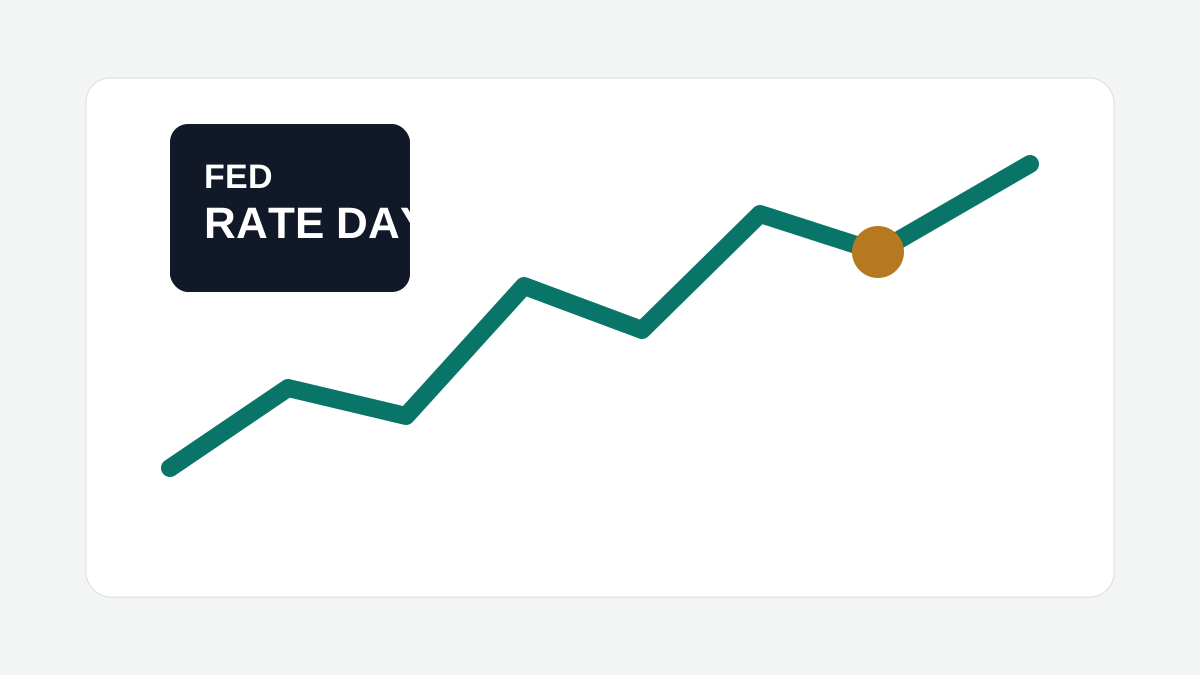
A Federal Reserve interest-rate decision is one of the few scheduled events that can change the tone of the entire market in a single afternoon. The rate itself matters, but investors also need to watch the statement language, economic projections, press-conference tone, and the bond market’s immediate reaction.
The best preparation is not a prediction. It is a checklist. Investors should know which assets are most exposed to a surprise, what the market has already priced in, and where follow-through would confirm or reject the first move.
What the Market Is Really Pricing
Before the announcement, review Fed funds futures, Treasury yields, the dollar, and rate-sensitive sectors. If the market already expects no rate change, the larger move may come from language about inflation progress, employment risk, or the timing of future cuts.
A hawkish surprise usually shows up first in the front end of the Treasury curve and can pressure long-duration growth stocks. A dovish surprise may help growth and speculative areas, but only if investors believe the shift is about controlled inflation rather than economic weakness.
Watch the Two-Year Yield
The two-year Treasury yield is often the cleanest real-time signal for Fed expectations. If equities rally while the two-year yield rises sharply, the move may be fragile because the rate market is not confirming easier policy.
Sectors Most Exposed to the Decision
Banks, homebuilders, utilities, REITs, small caps, and high-multiple technology names can all react differently to the same decision. The key is duration and financing sensitivity. Companies that depend on cheap capital tend to benefit more from falling yields and suffer more when yields rise.
Investors should also watch financial conditions. A Fed that sounds comfortable with easier conditions may support risk assets. A Fed that pushes back against speculation can quickly reset momentum.
A Practical Fed-Day Checklist
Write down your expected market reaction before the announcement, then compare it with what actually happens. Track the S&P 500, Nasdaq, Russell 2000, the two-year yield, the ten-year yield, the dollar, and high-yield credit spreads.
Avoid treating the first five minutes as the final answer. Fed days often produce two-way volatility as algorithms react to headlines before investors digest the press conference.
Federal Reserve interest rate decision in a Real Investor Workflow
The most useful way to apply Federal Reserve interest rate decision is to treat it as a workflow rather than a prediction. Start by marking the next scheduled catalyst on the market calendar, then list the assets most exposed to that catalyst, the consensus view, and the risk of a second-day reversal if the first move is driven by positioning instead of fundamentals.
A strong workflow also separates headline direction from confirmation. Investors should compare index performance, Treasury yields, credit spreads, and sector breadth before they assume the market has reached a durable conclusion. That process is especially important when a popular narrative is already crowded and the first reaction rewards speed more than accuracy.
When the setup is clear, the article’s keyword becomes a practical screen for decision-making. If price action, macro data, and earnings revisions all agree, investors can lean more confidently into the trend. If they conflict, the right move is usually patience, smaller sizing, or a shorter review window instead of aggressive forecasting.
Mistakes Investors Make With Federal Reserve interest rate decision
One recurring mistake is assuming that a compelling macro story automatically leads to profitable trades. Federal Reserve interest rate decision may explain why the market is nervous or optimistic, but returns still depend on valuation, positioning, and time horizon. Good analysis can still produce a poor trade if the setup was already priced in.
Another mistake is focusing on a single indicator while ignoring the rest of the tape. A market insight article is most valuable when it is tested against liquidity, breadth, sector leadership, and the event calendar. Investors who monitor only one input often react late, over-size positions, or confuse noise with confirmation.
The better habit is to write down what would confirm the thesis, what would challenge it, and which related articles on this site can fill the information gap. That small discipline turns market commentary into a repeatable process rather than an opinion you defend after the market changes its mind.
A 30-Day Checklist for Federal Reserve interest rate decision
One of the easiest ways to improve decisions around Federal Reserve interest rate decision is to build a 30-day checklist. Mark the next catalyst on the calendar, decide which indicators or earnings reports could change the thesis, and write down which positions would benefit, which positions would be at risk, and which names belong on a watchlist rather than in the portfolio right now.
The checklist should also include a simple before-and-after process. Before the event, note expectations, valuation, sentiment, and the price trend. After the event, compare the real outcome with those expectations and look for confirmation from related assets. Investors who keep that structure are less likely to overreact to noisy headlines and more likely to notice when the market is sending a different message than the commentary cycle.
This approach is useful because it converts a broad topic into a sequence of small decisions. Instead of asking whether the entire market thesis is right, investors can ask whether the next release, next earnings report, or next trend confirmation made the setup stronger, weaker, or merely more crowded.
When to Be Patient With Federal Reserve interest rate decision
Not every valid insight deserves immediate action. Federal Reserve interest rate decision may be directionally correct while still offering poor timing because volatility is elevated, the market has already made a large move, or too many related assets are leaning on the same assumption. Patience is often a better edge than speed when the reward-to-risk has already compressed.
Investors should be especially cautious when the thesis depends on several things going right at once. If earnings need to improve, yields need to stay calm, and sentiment needs to remain supportive, then the setup is more fragile than a simple bullish or bearish narrative suggests. In those situations, smaller sizing or waiting for a cleaner entry is usually more rational than forcing a trade for the sake of activity.
Being patient does not mean being passive. It means updating the watchlist, refining price levels, and deciding what confirmation would justify action later. That discipline is one of the main differences between reacting to content and using content as part of a real investment process.
Investor FAQ
These quick answers reinforce how to use Federal Reserve interest rate decision in a disciplined, event-aware investing process.
Why does Federal Reserve interest rate decision matter for investors?
Federal Reserve interest rate decision matters because it helps investors connect a scheduled event or market theme with valuation, positioning, and risk management. The keyword is useful only when it leads to a clearer watchlist, better sizing, and more disciplined reactions around the next catalyst.
In practice, that means the topic should help investors decide what to monitor before a release, what to compare after the release, and how much portfolio risk deserves to be attached to the idea. If it cannot improve those decisions, it is interesting but not yet investable.
What should investors track alongside Federal Reserve interest rate decision?
Investors should pair Federal Reserve interest rate decision with price action, Treasury yields, sector leadership, estimate revisions, and the market calendar. Looking at only one signal usually produces a weaker read than comparing several confirming or conflicting inputs.
The exact mix changes by category, but the principle does not. Reliable investing decisions come from triangulation, not from treating one chart or one headline as a complete answer.
How often should a Federal Reserve interest rate decision thesis be reviewed?
Review the thesis whenever a major scheduled catalyst arrives, when market pricing changes sharply, or when related articles on the site reveal a stronger or conflicting signal. A good thesis survives updates; it should not depend on never being tested.
That review cycle matters because markets keep repricing the same theme through different data points. Investors who revisit the thesis on schedule are less likely to anchor on stale assumptions or react emotionally after a large move has already happened.
Conclusion
The right Fed-day process is simple: know what is priced in, identify the assets most exposed to a surprise, and wait for confirmation from rates and credit. Use the calendar to prepare before the announcement instead of reacting after the move is already crowded.